
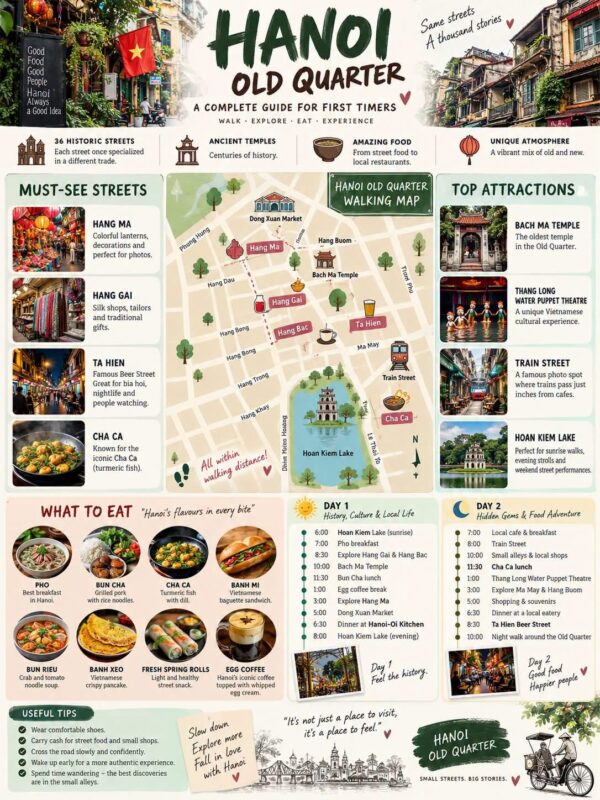
Hanoi Old Quarter Guide: Best Food & Sights In 36 Streets
The Hanoi Old Quarter is the grid of 36 guild streets just north of Hoan Kiem Lake, and for many travelers it’s the first place they go in Vietnam. It isn’t large — you can walk across it in about an hour — but packed inside are hundreds of food stalls, centuries-old temples, and a network of alleys that locals still call the quarter that never sleeps.
This guide covers everything you need for one day in the Hanoi Old Quarter: where to go, what to eat, an hour-by-hour itinerary, and the mistakes first-timers usually make.
What is the Hanoi Old Quarter?
The Hanoi Old Quarter (or “36 guild streets”) is the oldest surviving residential and commercial district in the capital, in Hoan Kiem District, immediately north of Hoan Kiem Lake. It took shape under the Ly and Tran dynasties and grew rapidly under the Le, when craft guilds concentrated each trade on its own street.
The distinctive part: every street name still points to a trade. Hang Bac was silver and gold, Hang Non sold hats, Hang Quat made paper fans, Hang Duong dealt in sugar and sweets, Hang Ma sold votive paper goods, and Lan Ong was the herb street. “36 guild streets” is the historic count — the area holds more than 36 roads today, but the name stuck.
Where is the Hanoi Old Quarter and how to get around
- Location: Hoan Kiem District, north of Hoan Kiem Lake, central Hanoi.
- From Noi Bai Airport: about 25 km; a taxi or pre-booked car takes 30–45 minutes depending on traffic.
- Getting around: walking is the best option. The quarter is small, the alleys cross over each other, and cars are barred from many stretches during rush hour. For longer hops, use a motorbike taxi, regular taxi, or cyclo.
If your hotel is in Hoan Kiem District, you can walk straight into the Old Quarter — no vehicle needed.
Where to go in the Hanoi Old Quarter
1. Hoan Kiem Lake, Ngoc Son Temple and Turtle Tower
Hoan Kiem Lake is the natural starting point for any walking route. Strolling around the lake is free, you can see Turtle Tower on its small island (the island is closed to visitors), and you cross the red The Huc Bridge to reach Ngoc Son Temple. The temple charges a small fee; the lakeside does not. Early morning is the quietest time — after 9am the crowds build.
2. Dong Xuan Market
Dong Xuan Market (built in 1889) is the largest covered market in the Old Quarter, at its northern edge. The ground floor sells fabric, clothing and dry goods; the upper floors carry household items of every kind. This is where you see how Hanoi actually shops, not just where you buy souvenirs.
3. The Train Street
A stretch of railway runs flush against the walls of people’s houses, with a few cafes setting tables right beside the tracks — travelers call it the Train Street, and it’s one of the most photographed spots in Hanoi.
Note: some trackside cafes were closed by the city for safety reasons, and access changes without notice. Check before you go, and don’t build your whole day around it.
4. St. Joseph’s Cathedral
St. Joseph’s Cathedral (built in the late 19th century, Gothic style) sits at the southeast edge of the quarter. The small square out front is where people sit with a coffee, take photos, and catch the breeze in the evening.
5. Weekend Night Market & Walking Streets
From Friday evening to Sunday evening, the streets around Hoan Kiem Lake close to motorbikes and cars and become a pedestrian zone. There’s street music, grilled skewer stalls, and impromptu games. If you’re in Hanoi over a weekend, don’t skip it.
What to eat in the Hanoi Old Quarter
The food is the best part of the Old Quarter. Here’s what to try, ordered by time of day.
Pho (morning)
Hanoi pho is different from southern pho: the broth is clear, less sweet, and the rice noodles are thin and slightly chewy. Pho bo tai (rare beef) and pho ga (chicken) are the two standard orders. The best spots are usually small, with a morning queue, and many sell out and close by mid-morning.
Bun cha (lunch)
Bun cha is the classic Hanoi lunch: cold rice vermicelli, charcoal-grilled pork patties, a sweet-and-sour fish sauce dip, and green papaya. Bun Cha Hang Manh at 37 Hang Manh is one of the most famous in the quarter — you smell the charcoal smoke before you see it. At lunch it gets packed and you may end up seated on the sidewalk.
Cha ca La Vong
Cha Ca La Vong (14 Cha Ca Street) is the restaurant an entire street is named after: turmeric fish grilled and stir-fried with dill and spring onion, served with vermicelli and shrimp paste. It’s been open since the late 19th century.
Banh xeo and banh cuon
Two dishes that often share a stall: banh xeo (a thin, crispy crepe filled with pork and shrimp, eaten with herbs) and banh cuon (steamed rice rolls filled with minced pork, scattered with crispy shallots). Both are cheap, hot, and fast.
Egg coffee
Egg coffee is a Hanoi original: strong black drip coffee underneath a thick, lightly sweet whipped egg foam on top. Cafe Giang at 39 Nguyen Huu Huan is said to have invented it in 1946, using egg in place of fresh milk during a shortage.
Trang Tien ice cream
Trang Tien Ice Cream (35 Trang Tien) is the old-school creamery by Hoan Kiem Lake, open since the 1950s. Cinnamon, coconut and mung bean are the flavors people order.
Fresh beer at Ta Hien (evening)
The corner of Ta Hien and Luong Ngoc Quyen is Hanoi’s most famous bia hoi corner. Draft fresh beer is cheap, poured from kegs, and drunk with grilled skewers. Evenings here are loud, crowded, and genuinely fun — you’ll sit on a plastic stool on the sidewalk, shoulder to shoulder with strangers.
One-day itinerary for the Hanoi Old Quarter
Morning (6:30–10:30) — Breakfast and the guild streets. Start with a bowl of pho at a small spot before 8am. Walk along Hang Dao → Hang Ngang → Hang Duong, the three oldest merchant streets. Get egg coffee at Cafe Giang, or sit on a plastic stool for a drip phin coffee on the sidewalk. Detour down Lan Ong to smell the dried herbs.
Midday (11:00–14:00) — Bun cha and the lake. Lunch at Bun Cha Hang Manh. Circle Hoan Kiem Lake, cross The Huc Bridge to Ngoc Son Temple, then duck into Dong Xuan Market to escape the heat.
Afternoon (14:30–18:00) — Train Street and the cathedral. Head to the Train Street and check whether the cafes are open. Move on to St. Joseph’s Cathedral and sit in the square out front. On the way back, stop at Hang Ma for votive paper goods or a small souvenir, then grab Trang Tien ice cream by the lake.
Evening (18:30 onward) — Fresh beer and the walking streets. Drink bia hoi at the Ta Hien corner with grilled skewers. If it’s a weekend, walk the pedestrian streets around Hoan Kiem Lake until you’re tired.
Tips for first-timers
- Go as early as you can. Before 8am the quarter is quiet and cool — that’s when the photos come out best.
- Carry small cash. Many small stalls and sidewalk vendors don’t take QR payments.
- Dress modestly for temples. Sleeves and knee-length trousers or a long skirt.
- Don’t try to “see all 36 streets.” Pick 5–7 stops and spend more time eating than walking.
- Best season: September to November. Hanoi’s autumn is cool and dry. March and April are good too. Summer (June–August) is hot and humid with rain; winter (December–February) is cold with drizzle.
- Watch for motorbikes. Sidewalks are narrow and bikes do ride up onto them. Stay alert, especially at alley crossings.
Frequently asked questions about the Hanoi Old Quarter
1. Where is the Hanoi Old Quarter? It’s in Hoan Kiem District, immediately north of Hoan Kiem Lake in central Hanoi, about 25 km from Noi Bai Airport.
2. Why is it called the 36 guild streets? Each street historically specialized in one craft or product — Hang Bac (silver), Hang Non (hats), Hang Quat (fans), Hang Duong (sugar), Lan Ong (herbs), and so on. Thirty-six is the historic count; the area has more roads today, but the name stayed.
3. Is there an entrance fee for the Hanoi Old Quarter? No. Walking the streets is completely free. Only specific sites within it, such as Ngoc Son Temple, charge a small entry fee.
4. When is the best time to visit the Hanoi Old Quarter? September to November is ideal — cool and dry. March and April are comfortable too. Summer is hot and humid, winter is cold with drizzle, but the quarter stays busy year-round.
5. How long does it take to walk through the Hanoi Old Quarter? Straight through without stopping, about 1–2 hours. But most travelers spend half a day to a full day eating, drinking coffee, and sitting still.
Wrapping up
The Hanoi Old Quarter isn’t a place you “visit” for an hour. It’s where you have pho for breakfast, egg coffee mid-morning, get lost in a narrow alley, and end the day with fresh beer at Ta Hien. Don’t try to conquer all 36 streets — sit down, order something, and let the quarter happen to you.
Vietnam Monthly Travel Guide: 12 Best Spots
If you’re heading to Hanoi, browse our day tours (insert internal link to your Vietnam Tour / Hanoi tour page) or reach us directly:
- Phone / Zalo: +84 888 729 339
- Email:
- Address: 135B Au Co, Tay Ho, Hanoi